An essay by Bob Zielsdorf · April 2015
Meeting Father Ted
In September 2014, Bob and Fran returned to Notre Dame. A copy of Sealed with a Kiss and a friend's encouragement had opened a door. This is Bob's account, written in April 2015, of the visit and the farewell that followed.
Long before celebrities routinely went by brief soubriquets like Dr. Phil or Oprah, the Reverend Theodore Martin Hesburgh needed no last name to be immediately recognizable. To anyone associated with the University of Notre Dame and tens of thousands beyond the campus borders, he was simply “Father Ted.” As president of the university for 35 years, the longest tenure of any of the school’s presidents, he oversaw the doubling of the university’s size, an exponential growth in its endowment, and its transition to coeducation. In the world at large he served on Presidential commissions and as chairman of prestigious foundation boards; one source suggests that he earned the most honorary degrees, 150, awarded to any single person.
As a student at Notre Dame in the early 1960s, I felt both awe and a kind of affection for this larger-than-life figure who seemed so inextricable from the spirit and character of the University. When I wrote a memoir, Sealed with a Kiss: An American Love Story in Letters, that described my college years, I was vividly reminded of him again. At the suggestion of a friend and Notre Dame Trustee, Jane Pfeiffer, I had sent Father Ted a copy of the book, receiving in return a most gracious thank-you note. Jane encouraged me to follow up on that, so I did.
Fran and I were going to be on the Notre Dame campus in September 2014, for the Irish Impact Conference on Social Entrepreneurism which we partially sponsor. I wrote to Father Ted saying we would be at Notre Dame, asking if it would be OK to stop by and say hello.
I don't think my letter was on his desk for ten minutes before his assistant, Melanie Chapleau, sent me an email offering a meeting time at 2:30 on Thursday, September 18. It was a gracious response on behalf of a man with a very crowded schedule.
Other friends had told me Father Ted very much enjoyed cigars. In fact, I learned that his office in the Hesburgh Library, with its special ventilation system, is the only place on campus where smoking is permitted. I decided I ought to offer him the small gift of a cigar but, having given up smoking 35 years ago, I had no idea what to look for. I consulted with Bob Dilenschneider, a classmate who is savvy on the issue. Bob recommended a box of Cohibas. Thinking a whole box of anything at our first meeting would be overkill, I settled on a single Macanudo, recommended by a cigar shop in South Bend.
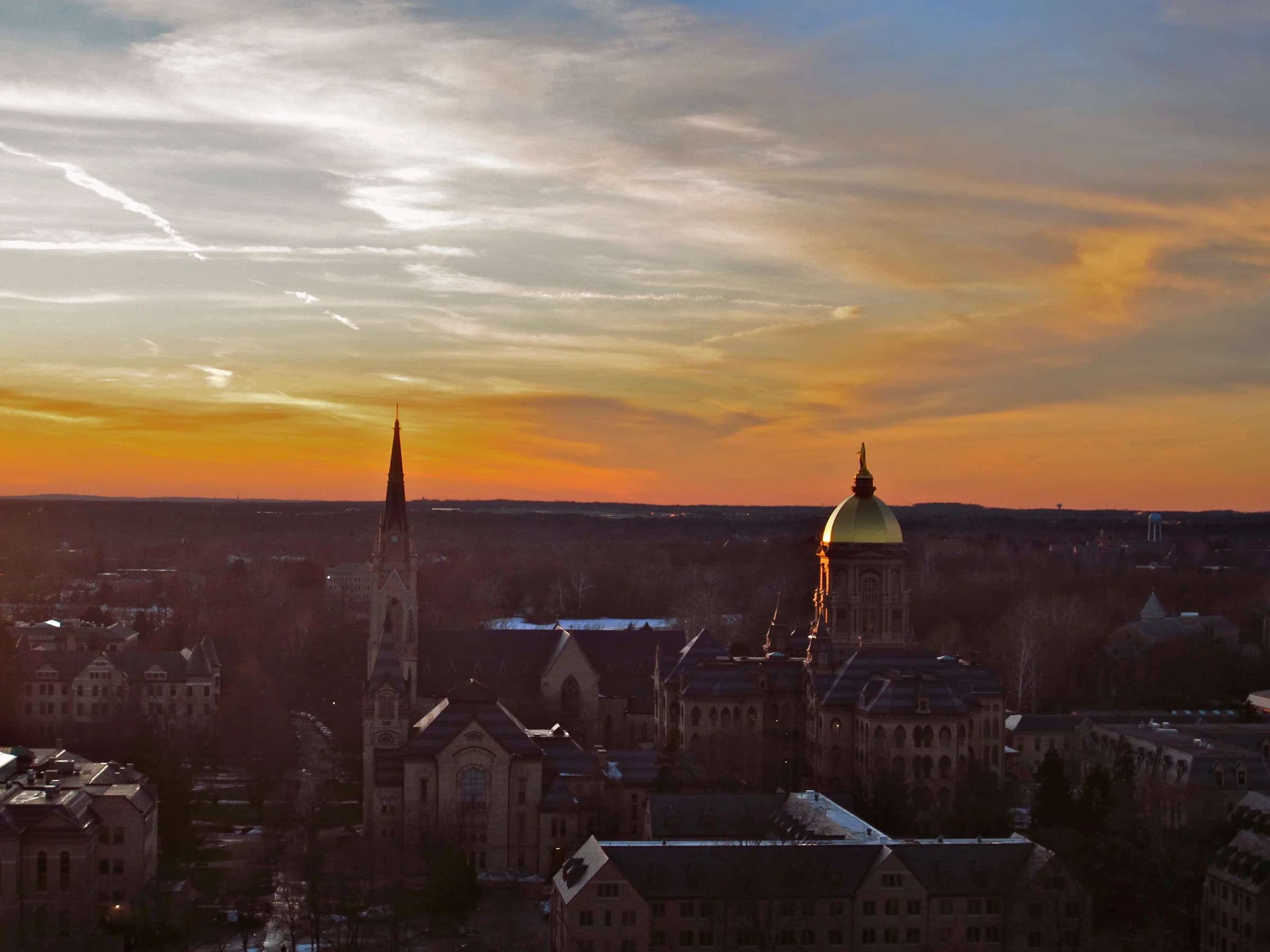
The day of the meeting was a particularly beautiful one in South Bend. There wasn't a cloud anywhere and the Golden Dome and its statue of Our Lady were brilliant against the blue sky. As Fran and I walked toward the Hesburgh Library, I was a bit apprehensive about the meeting. I had only met Father Ted face to face a couple of times as an undergraduate and both times I found myself uncharacteristically tongue-tied. Around 25 years ago I met him again when he was the guest of the Dayton Alumni Club for the Universal Notre Dame night celebration. I was less tongue-tied then but there wasn't much opportunity to talk anyway. What in the world would we discuss when we were one-on-one in his office?
Fran was even more apprehensive, but for a different reason. She is extraordinarily allergic to second-hand smoke. She has actually contracted sinus infections after very brief exposures to someone else's cigarette. As much as she wanted to meet Father Ted, she was afraid of getting sick. We talked it over, agreeing that she should give it a shot but also that, if she sensed the smoke was becoming a problem, she could leave.
Once we got to the Library, it took a bit of searching to locate the elevator that would take us to the 13th floor. When we exited the elevator all we could see was the warren of bookshelves, comprising the stacks of whatever academic subjects are featured on that floor. Don't ask me why, but I had expected to exit the elevator and see an imposing mahogany entry door, something like one would see at a big-time law firm in a Manhattan highrise. Where in the world was Father Ted? Following some instinct, we wound our way through the stacks to the opposite side of the floor and, very happily, found the rather ordinary door that was the entrance to Father Ted's office suite.
Melanie greeted us, saying that Father Ted still had someone with him and asking us to please wait in the adjoining room. What we found wasn't so much a room as a small museum showcasing hundreds of plaques, photos, awards, and sports and academic memorabilia from a lifetime at the University. I had the distinct feeling that we were seeing only a few of the items Father Ted had surely accumulated over his long career. At the risk of speculating, let me say the others might easily fill a small warehouse. Maybe one of Father Ted’s staff rotates the displays periodically, as most museums do.
After a short time, it was our turn and Melanie led us down a hallway to Father Ted's office. The cigar odor was already apparent by the time we were 20 feet from the door. Fran just couldn't go further, so back she went to the waiting area and in I went to meet Father Ted.
The office is spacious with a large picture window featuring a spectacular view of the Golden Dome. Father Ted was seated at his desk but well behind it. He was a person very much at ease in his space and he immediately put me at ease as well. He was casually dressed in black with a lit cigar in his left hand. His voice was calm and reassuring.
Father Ted and I shook hands and I took a seat in one of the guest chairs to his right while trying to explain why Fran was not with me. He graciously offered to put down his cigar but I had to say thank you but no thank you. Thus began the meeting that became one of the highlights of that year for me.
I wish now I could recall every word we spoke, every subject we discussed. The truth is I was awed by Father Ted, knowing the extraordinary things he had accomplished and his immense impact on the University and world. I knew I was in the presence of greatness. That had the effect of immediately blurring much of my memory, I struggled to recall details for Fran afterward. But some key things are vivid.
Among the things I can recall about our meeting is thinking he looked wonderful. I mentioned that and asked how he was doing. His response was, “When you're 97 and a half and you can wake up every day and go to work, you're doing well.”
I observed that he must be very proud of what he had created at Notre Dame, both during and since his tenure as President. His response was extraordinarily modest but he allowed that he was particularly proud of the Institute for International Peace Studies. He went on to say how important and urgent he felt it was for people to find ways to live in harmony.
After a while, I felt I should start to say my good-byes. Even though I had the sense he would have talked a great deal longer, I didn't want to monopolize his time. As I was preparing to leave he said, “You know, your wife can't come all the way up here and not at least come in to say hello.” So off I went and convinced Fran she'd be all right if she only stayed a minute.
Father Ted greeted her warmly. We hadn't discussed his macular degeneration but I knew Father Ted could see very little. In spite of that handicap, he proudly described for Fran the view from his window, remarking how special it's that he was at the same level as the statue of Our Lady and how fortunate for him that was. We knew that in his mind he was seeing Our Lady as clearly as we were.
As I’ve said, my book, Sealed With a Kiss, was the original impetus for this meeting. Father Ted had severe macular degeneration that prevented him from reading printed material. Instead people, including student volunteers, would read to him. My hope is that someone at least did read him some excerpts. He didn't mention it and I didn't want to put him on the spot by asking. I suppose I'll never know.
Some five months later, on February 26, 2015, Father Ted passed away. I heard about the tremendous outpouring of love and respect for him that subsequently took place on campus. Our grandson, Matthew Alexander, is a freshman at Notre Dame this year, so I asked him to tell me his experience of the celebration of life that took place on campus over a two-day period.
On the first day, March 3, the university conducted public visitations and a wake service in the Sacred Heart Basilica on campus. The following day was the funeral mass, followed by a procession from the Basilica to the burial site in the Holy Cross Community Cemetery. It was very cold in South Bend that day, the high temperature was barely 20 degrees Fahrenheit. In spite of that, the student body turned out in droves for the procession, properly dressed in suits and dresses, and lined the route in respectful silence.
The evening of the procession a Memorial Tribute took place in the Purcell Pavilion on campus. Students lined up for hours in the cold. The Pavilion became packed with them, plus alumni, friends, and guests from all over the world. For Matthew, it was a powerful experience. Among the many things that struck him was the fact that, though there was great sadness, the event truly was a celebration of life.
From the many speakers telling their stories about Father Ted, Matthew came away with a deeper sense of what the Notre Dame community represents. As he told me, “I didn't know Father Ted but I learned how he touched the lives of so many people.” Speakers included Condoleeza Rice and President Jimmy Carter. President Obama even made an appearance, piped remotely onto the enormous screen in the athletic facility. Matthew was amazed at the influence Father Ted had wielded at every level of our society. He treasures the bronze commemorative coin featuring Father Ted's likeness that was presented to each guest.
In the days that followed, one of Matthew’s professors took class time to talk about how Father Ted had touched her own life. I asked Matthew if there was much in the way of dorm bull- sessions discussing Father Ted's life. It turns out that the modern equivalent of bull-sessions are social media sites. Notre Dame's social media presences were taken over for many hours with students telling their own stories about Father Ted. Clearly his powerful presence is still felt at Notre Dame, and his memory will not be quickly forgotten.
Since the day he made the decision to enroll at Notre Dame, Matthew has always made it clear how much he loves being a Notre Dame student But as he witnessed this unique and powerful solidarity and togetherness of the Notre Dame community, his own dedication to the university was strengthened. As he told me at the end of his description of the memorials, “I knew for certain I made the right choice.”
Readers of Sealed With a Kiss know that my own love for and dedication to Notre Dame matured later in my student career there. It pleases me beyond measure to know my grandson is years ahead of me in this respect.
In the words of the alma mater, “Praise thee Notre Dame. And our hearts forever, Love thee Notre Dame.” As for Father Ted, he will be in our hearts forever, too.